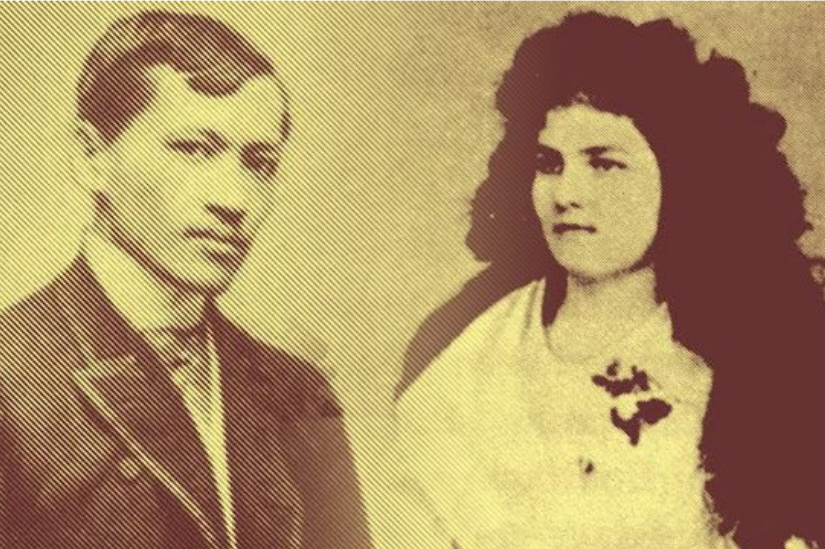
Segunda Katigbak and Leonor Valenzuela
Segunda Katigbak was her puppy love. Unfortunately, his first love was engaged to be married to a town mate- Manuel Luz. After his admiration for a short girl in the person of Segunda, then came Leonor Valenzuela, a tall girl from Pagsanjan. Rizal sent her love notes written in invisible ink, that could only be deciphered over the warmth of the lamp or candle. He visited her on the eve of his departure to Spain and bade her a last goodbye.
While Rizal was in London annotating the Sucesos de las Islas Filipinas, he boarded in the house of the Beckett family, within walking distance of the British Museum. Gertrude, a blue-eyed and buxom girl was the oldest of the three Beckett daughters. She fell in love with Rizal. Tottie helped him in his painting and sculpture. But Rizal suddenly left London for Paris to avoid Gertrude, who was seriously in love with him. Before leaving London, he was able to finish the group carving of the Beckett sisters. He gave the group carving to Gertrude as a sign of their brief relationship.
Nellie Boustead
Rizal having lost Leonor Rivera, entertained the thought of courting other ladies. While a guest of the Boustead family at their residence in the resort city of Biarritz, he had befriended the two pretty daughters of his host, Eduardo Boustead.
Rizal used to fence with the sisters at the studio of Juan Luna. Antonio Luna, Juan’s brother and also a frequent visitor of the Bousteads, courted Nellie but she was deeply infatuated with Rizal.
In a party held by Filipinos in Madrid, a drunken Antonio Luna uttered unsavory remarks against Nellie Boustead. This prompted Rizal to challenge Luna into a duel. Fortunately, Luna apologized to Rizal, thus averting tragedy for the compatriots.
Their love affair unfortunately did not end in marriage. It failed because Rizal refused to be converted to the Protestant faith, as Nellie demanded and Nellie’s mother did not like a physician without enough paying clientele to be a son-in-law. The lovers, however, parted as good friends when Rizal left Europe.
Usui Seiko (O Sei San)
Usui Seiko, more popularly known as O Sei San, and Udagawa Okiyo intersected the lives of national hero Jose Rizal (1861-1896) and Mariano Ponce (1863-1918), respectively, during the two reformists’ stay in Yokohama, a port city some 40 km south of Tokyo.
Rizal was on a six-week stay in Yokohama enroute to Europe via the United States in the spring of 1888 when he met Usui. Ponce was detailed there as diplomatic representative of the Emilio Aguinaldo-led First Republic from June 1898 to September 1899, during which time he courted Udagawa.
Usui has gone down in Philippine history as Rizal’s Japanese romantic interest who introduced him to Japanese culture as they went on afternoon strolls talking in French. Udagawa became Ponce’s wife, left Japan with him, converted into Christianty, bore him children, and never returned to her homeland. Both women lived long enough to witness their Filipino beaus enshrined in the pantheon of Philippine national heroes and experience World War II from opposite sides.
If Rizal was a man without a patriotic mission, he would have married this lovely and intelligent woman and lived a stable and happy life with her in Japan because Spanish legation there offered him a lucrative job. However, Rizal knew that his country needed him, and so left her comfort in pursuit of his patriotic mission.
Josephine Bracken
In the last days of February 1895, while still in Dapitan, Rizal met an 18-year old petite Irish girl, with bold blue eyes, brown hair and a happy disposition. She was Josephine Bracken, the adopted daughter of George Taufer from Hong Kong, who came to Dapitan to seek Rizal for eye treatment.
Rizal was physically attracted to her. His loneliness and boredom must have taken the measure of him and what could be a better diversion that to fall in love again. But the Rizal sisters suspected Josephine as an agent of the friars and they considered her as a threat to Rizal’s security.
Rizal asked Josephine to marry him, but she was not yet ready to make a decision due to her responsibility to the blind Taufer. Since Taufer’s blindness was untreatable, he left for Hong Kong on March 1895.
Josephine stayed with Rizal’s family in Manila. Upon her return to Dapitan, Rizal tried to arrange with Father Antonio Obach for their marriage. However, the priest wanted a retraction as a precondition before marrying them.
Rizal upon the advice of his family and friends and with Josephine’s consent took her as his wife even without the Church blessings.
Josephine later give birth prematurely to a stillborn baby, a result of some incidence, which might have shocked or frightened her.